In a recent post, I shared how Chris Munce of the Choralosophy podcast adapted the Scarborough’s rope modelization of teaching reading, to music literacy. Please refer to the post for a detailed explanation of Scarborough’s rope.
Chris works in a high school, where choir rehearsals happen more frequently than for church choirs. Still I believe that some of these ideas can be implemented in our church choirs. Below is my first contribution to this conversation.
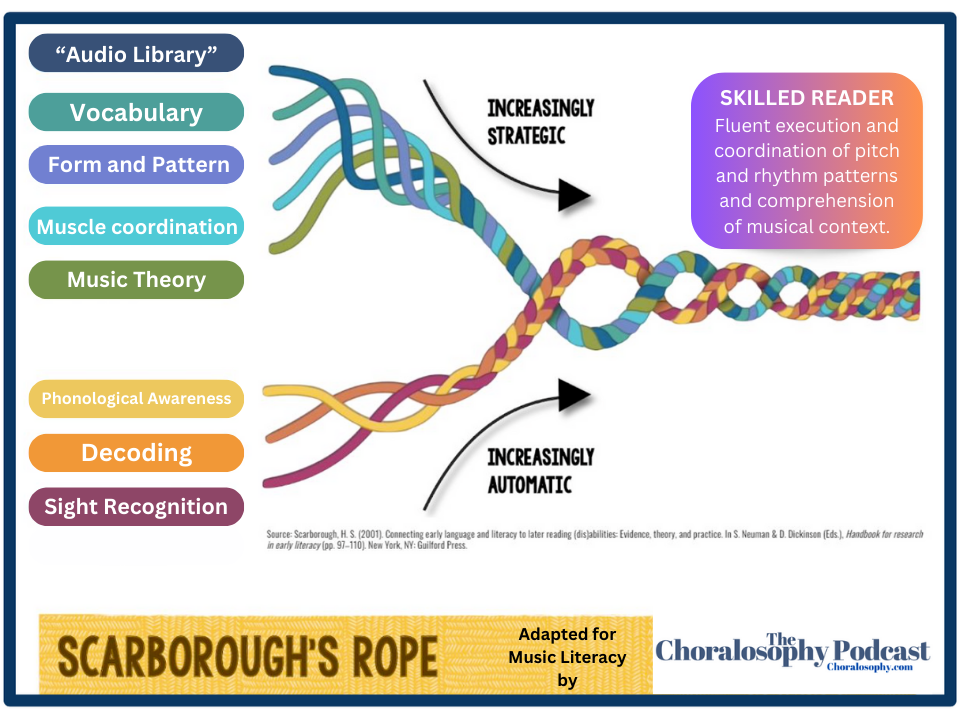
In my church choir, I segregate the teaching of automatisms (bottom 3 parts: Phonological awareness, Decoding, Sight recognition) in the normal rehearsal process (every other week for us), as we learn music for the next mass, while the five top skills are developed in dedicated “intensive” workshops. Of course, the rehearsals refer to what is learned in the workshops.
This hierarchy and chronology in preparation is especially suited to the Catholic liturgy which already recognizes a hierarchy in participation and in solemnity (see introduction to participation). In short we distinguish three phases of preparation going backwards from the time of singing the mass:
- run-through of the music, a few minutes before singing mass,
- choir rehearsal, a few days before singing mass, when automatisms can be practiced along with learning new music,
- workshops to learn foundations (the five “strategic” skills on top), offered every few months to catholic singers who understand that singing the mass is a lifetime endeavor. Reminders of these foundations can be done in choir rehearsals.
Practicing automatisms in rehearsals:
- Sight recognition. Do not use a type of music notation that has not been explained first in a workshop (see false theories). It is therefore advantageous to use square notes. This happens to correlate with the “pride of place” given by the Church to chant. The natural complement to square notes is solfege and the Movable Do. They can be easily explained in a short workshop (see example here). The systemic practice of solfege to learn new hymns will then develop automatisms (example here).
- Decoding1. Again, using a type of music notation that is accessible to the pupils is a pre-requisite. With the simplified notation of the Roman Gradual (or the Pew Missal, Source & Summit, Graduale Simplex,…), decoding follows this path: identify where the 1/2 step is, use short ascending and descending scales (do-re-mi-fa-so or do-ti-la-so-fa) to identify notes, then skip notes, then recognize intervals (3rd, 4th 5th), patterns (ex: minor triad vs. major triad)…
- Phonological Awareness. This is also called audiation, and is fundamental for singers to learn how to read music. Unlike instrumentalists, singers must think the sound in their head before they voice it. Relying on a keyboard is not really helpful. Developing this automatism requires discipline from the choirmaster: it still is difficult to let the singers fix their own problems, to not sound the answers. It is slower to teach music in the short term. Much quicker in the long term.
Developing strategic skills:
- “Audio Library”. No singer starts with zero sound. We all know a tune. That is a great place to start with each individual singer. See examples here. I have pointed out often that singing “Happy Birthday” already uses a considerable audio library, really too complex for beginners. Recitation tones and simple mass responses are also used to identify simple intervals.
- Vocabulary. Choir members will have to learn the definition of a few words: scale, interval, dynamics, full step, half-step, tempo, minor, major, key signature, DO clef, FA clef,…
- Form and Pattern. Recognizing frequently used patterns like major triads or minor triads. Using psalm tones in the mass, and teaching the eight Gregorian modes will also develop patterns that can easily be recognized and enrich the audio library.
- Muscle coordination. Singing is a physical activity, and poor management of the breath is the cause of most vocal problems.
- Music theory. The movable DO method of reading music will be developed faster for singers than a fixed DO. The pattern of the diatonic scale will then be recognized on a modern staff, thanks to the circle of fifths, and the chromatic notes added. The overwhelming majority of the music used in Church use a diatonic scale, while we stubbornly present our choir members and congregations with music sheets with many flats and sharps!
Does this work? Yes. Does it slow down the learning of music for mass. Also yes. Initially. But after two years of rehearsing only twice a month, I now have 4 teenagers who had no reading or singing experience, and now can sight-read alone most Introit and Communion antiphons from the Roman Gradual. Do I need help to now reconcile the growing spread between the most advance readers, the new recruits to the choir, and even more with the average singer of the congregation? Yes. But we will keep the focus on teaching sight reading to more singers rather than developing a small group in charge of doing all the singing. We learned that much in the past two years.
- If you find it difficult to recruit volunteers for your choir, try teaching them “decoding” first, then all the other skills listed above. Choir members who experience such success will start arriving early at your next rehearsal, tell you about the decoding they were able to practice at home, and tell their friends how excited about their new skills of decoding music. ↩︎
 Long Beach Chant