Fear of singing… are we afraid to even talk about it?
These four minutes are part of a longer 1-hour talk , and are really, really worth our time. In four minutes, Talia Sheehan expertly describes why people are often terrified of singing. Two reasons:
- they are afraid of being rejected,
- they afraid of the powerful emotions unleashed by singing: pure joy, defined as a mix of grief and elation,
In a previous post, titled “they went to their death singing“, we heard of that joy, which was witnessed until the moment of death. Christian martyrs have always been known for their singing.
But now Catholics seem afraid of singing. Yet fear of singing is rarely discussed.
Singing in worship is supposed to be safe. The safest place to sing, in fact. The place where we learn to experience that overwhelming, intimidating joy. Thanks to the simple dialogues of the mass, also called the first degree of participation, singing in worship is “incremental exposure therapy”, group therapy!
She also explains in simple words the Zone of Proximal Development (ZPD) and why learning to sing in worship is like being trained into courage. To do so, “battle-tested” leadership is essential. It is up to experienced singers to lead new singers.
Ignoring this ZPD, or bad leadership, can create fear, shame, anger, and detachment, or outburst.
Please, please watch these 4 minutes…
You can also watch the full 1-hour talk by Talia Sheehan at this link.
December – January
(New to this website? See a 4-minute video describing it. ).
Learn how to read music here.
Click on the coming Sundays to download sheet music and sound files of the sung Proper of the Mass. (Click here for the 1962 Traditional Calendar) The sound files are unaccompanied (a-cappella) to replicate as closely as possible the conditions of individual practice at home. Three versions:
- Roman Gradual, in Latin (the universal and official music of each Mass)
- Two English translations: a very simple one, and another closer to the Latin, original language of the Roman rite.
Friday, February 2, The Presentation of the Lord white
Sunday, February 4, FIFTH SUNDAY IN ORDINARY TIME green
Sunday, February 11, SIXTH SUNDAY IN ORDINARY TIME green
Continue reading →Reading the music of the mass: adapting Scarborough’s rope to church choir rehearsals.
In a recent post, I shared how Chris Munce of the Choralosophy podcast adapted the Scarborough’s rope modelization of teaching reading, to music literacy. Please refer to the post for a detailed explanation of Scarborough’s rope.
Chris works in a high school, where choir rehearsals happen more frequently than for church choirs. Still I believe that some of these ideas can be implemented in our church choirs. Below is my first contribution to this conversation.
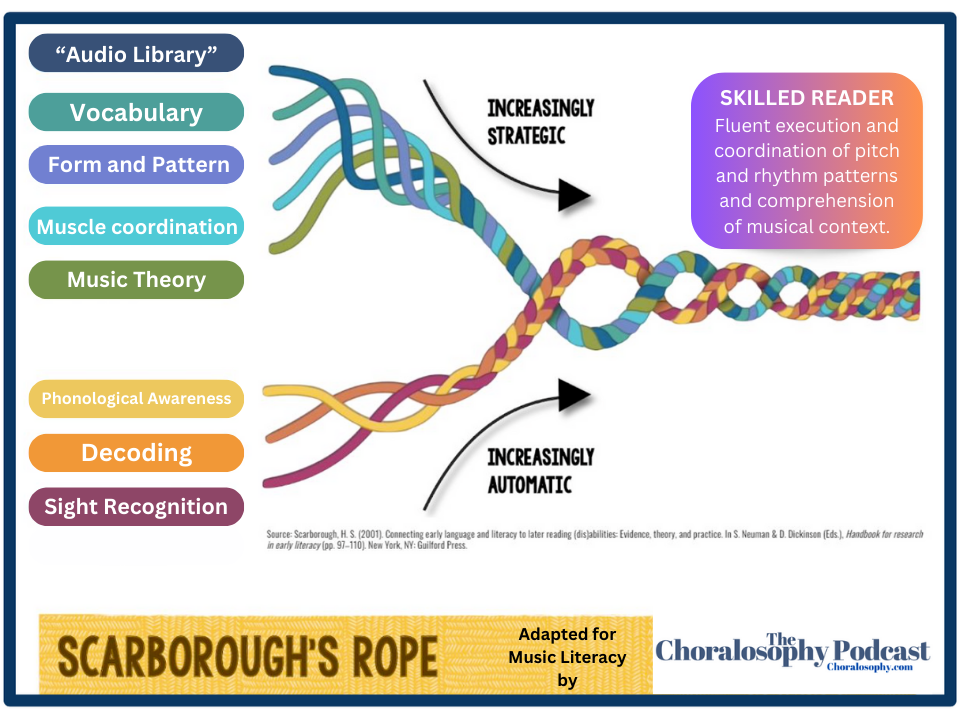
In my church choir, I segregate the teaching of automatisms (bottom 3 parts: Phonological awareness, Decoding, Sight recognition) in the normal rehearsal process (every other week for us), as we learn music for the next mass, while the five top skills are developed in dedicated “intensive” workshops. Of course, the rehearsals refer to what is learned in the workshops.
This hierarchy and chronology in preparation is especially suited to the Catholic liturgy which already recognizes a hierarchy in participation and in solemnity (see introduction to participation). In short we distinguish three phases of preparation going backwards from the time of singing the mass:
- run-through of the music, a few minutes before singing mass,
- choir rehearsal, a few days before singing mass, when automatisms can be practiced along with learning new music,
- workshops to learn foundations (the five “strategic” skills on top), offered every few months to catholic singers who understand that singing the mass is a lifetime endeavor. Reminders of these foundations can be done in choir rehearsals.
Practicing automatisms in rehearsals:
- Sight recognition. Do not use a type of music notation that has not been explained first in a workshop (see false theories). It is therefore advantageous to use square notes. This happens to correlate with the “pride of place” given by the Church to chant. The natural complement to square notes is solfege and the Movable Do. They can be easily explained in a short workshop (see example here). The systemic practice of solfege to learn new hymns will then develop automatisms (example here).
- Decoding1. Again, using a type of music notation that is accessible to the pupils is a pre-requisite. With the simplified notation of the Roman Gradual (or the Pew Missal, Source & Summit, Graduale Simplex,…), decoding follows this path: identify where the 1/2 step is, use short ascending and descending scales (do-re-mi-fa-so or do-ti-la-so-fa) to identify notes, then skip notes, then recognize intervals (3rd, 4th 5th), patterns (ex: minor triad vs. major triad)…
- Phonological Awareness. This is also called audiation, and is fundamental for singers to learn how to read music. Unlike instrumentalists, singers must think the sound in their head before they voice it. Relying on a keyboard is not really helpful. Developing this automatism requires discipline from the choirmaster: it still is difficult to let the singers fix their own problems, to not sound the answers. It is slower to teach music in the short term. Much quicker in the long term.
Developing strategic skills:
- “Audio Library”. No singer starts with zero sound. We all know a tune. That is a great place to start with each individual singer. See examples here. I have pointed out often that singing “Happy Birthday” already uses a considerable audio library, really too complex for beginners. Recitation tones and simple mass responses are also used to identify simple intervals.
- Vocabulary. Choir members will have to learn the definition of a few words: scale, interval, dynamics, full step, half-step, tempo, minor, major, key signature, DO clef, FA clef,…
- Form and Pattern. Recognizing frequently used patterns like major triads or minor triads. Using psalm tones in the mass, and teaching the eight Gregorian modes will also develop patterns that can easily be recognized and enrich the audio library.
- Muscle coordination. Singing is a physical activity, and poor management of the breath is the cause of most vocal problems.
- Music theory. The movable DO method of reading music will be developed faster for singers than a fixed DO. The pattern of the diatonic scale will then be recognized on a modern staff, thanks to the circle of fifths, and the chromatic notes added. The overwhelming majority of the music used in Church use a diatonic scale, while we stubbornly present our choir members and congregations with music sheets with many flats and sharps!
Does this work? Yes. Does it slow down the learning of music for mass. Also yes. Initially. But after two years of rehearsing only twice a month, I now have 4 teenagers who had no reading or singing experience, and now can sight-read alone most Introit and Communion antiphons from the Roman Gradual. Do I need help to now reconcile the growing spread between the most advance readers, the new recruits to the choir, and even more with the average singer of the congregation? Yes. But we will keep the focus on teaching sight reading to more singers rather than developing a small group in charge of doing all the singing. We learned that much in the past two years.
- If you find it difficult to recruit volunteers for your choir, try teaching them “decoding” first, then all the other skills listed above. Choir members who experience such success will start arriving early at your next rehearsal, tell you about the decoding they were able to practice at home, and tell their friends how excited about their new skills of decoding music. ↩︎
Adapting the science of reading to singing
Great video tackling myths about learning to read music:
3:30 : presenting the article about the science of reading, link to music literacy
4:40: the importance of reading in education, and of reading music for music education. Our current system does not work to teach reading efficiently to most students.
8:30: Fighting widespread false theories. Reading is not as natural as speaking. Educated guesses do not work. There are not hundreds of way to learn to read: the correct path is known and proven. Phonemic awareness (audiation), phonics (library), fluency, vocabulary, and comprehension must be taught
(14:50-15:20 advertising)
15:20: Scarborough’s reading rope.
19:55: adapting Scarborough’s rope to music literacy. Great segment!!
Resource to learn Gregorian Chant hymns
If listening and repeating is your preferred way* of learning Gregorian Chant, this webpage is a great resource:
https://gregorian-chant-hymns.com/hymns-2/
( * another way, more beneficial in the long term is to learn how to read Gregorian Chant with the Movable Do and solfege methods. You can start learning at this link )
October – November
(New to this website? See a 4-minute video describing it. ).
Learn how to read music here.
Click on the coming Sundays to download sheet music and sound files of the sung Proper of the Mass. (Click here for the 1962 Traditional Calendar) The sound files are unaccompanied (a-cappella) to replicate as closely as possible the conditions of individual practice at home. Three versions:
- Roman Gradual, in Latin (the universal and official music of each Mass)
- Two English translations: a very simple one, and another closer to the Latin, original language of the Roman rite.
Friday, December 8, THE IMMACULATE CONCEPTION OF THE white
Sunday, December 10, SECOND SUNDAY OF ADVENT violet
Sunday, December 17, THIRD SUNDAY OF ADVENT violet or rose
Continue reading →Why join the schola?
To learn how to prepare for missa cantata is the short answer.
We can distinguish three degrees of preparation, as there are also three degrees of participation to missa cantata.
The first degree is to review for a few minutes before mass that we actually know how to sing the parts that are ours. In a missa cantata, every baptized parishioner has a part to sing1. Also, it is a recent evolution that parishioners feel they can rely on musical instruments and do not need any preparation. As early as 1958, instruments were to remain silent2 for several months of the liturgical year. Relying on the instruments was then not an option. Delegating one’s preparation to fellow parishioners was, then as now, a common occurrence, but when everyone thinks they can delegate their participation, then missa cantata is no longer possible. Our schola rehearsals3 include the preparation of the congregation, and we spend a good amount of time preparing for the first and second degrees of participation, as they are the foundations for the third degree of participation, which is traditionally reserved to the schola.
The second degree of preparation is to study the liturgical calendar a few weeks ahead, to anticipate the music that will be sung, and to thus give ourselves time learn the treasures of liturgical music that the tradition gave us. If our generation does not learn these treasures, it will not be available for next generations.
The third degree of preparation is to embrace the Church tradition of music literacy, and to learn the simple solfege that enables a schola to sing the Graduale Romanum. Solfege was invented in the 11th century by the Church, for the very purpose of singing her liturgy. It is much easier than you think, and you can take the first step at this link.
These three degrees imply that you will have considerable flexibility in your schedule. The schola is not a performing group, but rather a school (schola) to prepare for missa cantata. The teacher is the Church and her tradition, handed to us in the liturgical books. The schola director is just there to coordinate the learning. The more members our schola has, the more flexible our schedules can be.
Please consider joining the schola! Talk to me after mass, call or email me to tell me what time you can commit to. We’ll have a solution to help you prepare better.
THANK YOU!
Hervé, St JP II Polish Center Latin Mass schola director. 626 278 0786 longbeachchant@live.com
- The parts to be sung in a Missa Cantata (Sung Mass) are defined by the degrees of participation in the 1958 instructions on Sacred Music and Sacred Liturgy (paragraphs 24 to 27) and also, in the Vatican II instructions, Musicam Sacram (paragraphs 28 to 31). The three degrees are mostly identical in both pre- and post-Vatican II documents. ↩︎
- See paragraphs 80 to 85 of the 1958 document already mentioned above ↩︎
- This post was prepared for the St JP II Polish Center Schola in Yorba Linda. Webpage at this link. ↩︎
August-September
(New to this website? See a 4-minute video describing it. ).
Learn how to read music here.
Click on the coming Sundays to download sheet music and sound files of the sung Proper of the Mass. (Click here for the 1962 Traditional Calendar) The sound files are unaccompanied (a-cappella) to replicate as closely as possible the conditions of individual practice at home. Three versions:
- Roman Gradual, in Latin (the universal and official music of each Mass)
- Two English translations: a very simple one, and another closer to the Latin, original language of the Roman rite.
Sunday, September 24, TWENTY-FIFTH SUNDAY IN ORDINARY TIME green
Friday, September 29, Saints Michael, Gabriel and Raphael, Archangels white
Sunday, October 1, TWENTY-SIXTH SUNDAY IN ORDINARY TIME green
Continue reading →Reading the Music of the Mass – Exercises and Next Class
Week 2 exercises (7/5- 7/10):
Level 1 of each (6): 3-DO on 4th line – Intervals: thirds – low , 4-DO on 4th line – Intervals: thirds – high , 11-DO on 3rd line – Intervals: thirds – low , 12-DO on 3rd line – Intervals: thirds – high , 19-FA on 3rd line – Intervals: thirds – low , 20-FA on 3rd line – Intervals: thirds – high
Catch up on previous weeks here: Introduction to the MOVABLE DO method .
Wednesday 7/12 – 7:00-7:30PM:
GOOGLE MEET – Minor 3rd vs. Major 3rd , “Perfect chord” vs. “Perfect Pitch”, Modal evolution
You can join the class at any time!
Week 3 Exercises (7/10 – 7/17):
Level 1 of each (6): 5-DO on 4th line – Intervals: fourths – low, 7-DO on 4th line – Intervals: fifths – low , 13-DO on 3rd line – Intervals: fourths – low , 15-DO on 3rd line – Intervals: fifths – low , 21-FA on 3rd line – Intervals: fourths – low , 23-FA on 3rd line – Intervals: fifths – low.
Wednesday 7/19 – 7:00-7:30PM:
GOOGLE MEET – Perfect 4th vs. Perfect 5th – Ochtoechos (Gregorian modes) – presentation of the Chant-specific slides
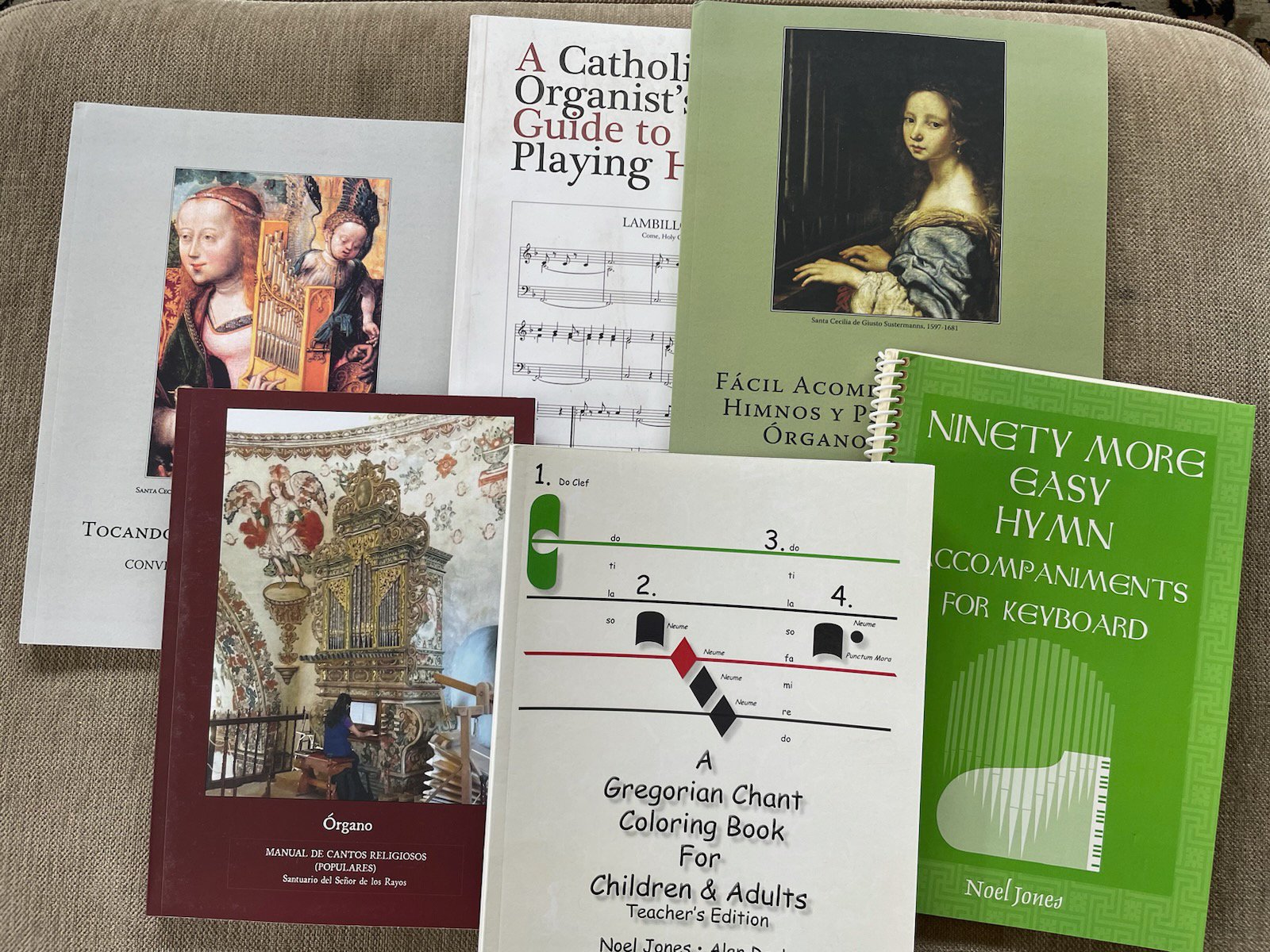
We have a Sponsor!! Thanks to https://sacredmusiclibrary.com/ , we have prizes: each student who finishes all 18 reading exercises in three weeks will get a free book (while supplies last, books are in Long Beach, CA) . See on the picture on the left which book is your first choice!
Week 4 Exercises (7/17 – 7/24):
The Parish Book of Chant :
Dialogues and Ordinary: Practicing solfege with the Parish Book of Chant (dialogues and ordinary)
Hymns: Practicing solfege with the Parish Book of Chant (Latin chant hymns)
Wednesday 7/26 – 7:00-7:30PM:
GOOGLE MEET – The circle of fifths, using the Movable Do with modern notation
Week 5 Exercises (7/24 – 7/31):
5-line staff
the Roman Missal: Practicing Solfege with the 2011 Roman Missal (ICEL)
Hymns: Practicing solfege with a Catholic Book of Hymns
Wednesday 8/2 – 7:00-7:30PM:
GOOGLE MEET – topics TBD
Week 6 Exercises (7/31 – 8/7):
Level 2 of each (6): 1-DO on 4th line – Intervals: seconds – low , 2-DO on 4th line – Intervals: seconds – high , 9-DO on 3rd line – Intervals: seconds – low , 10-DO on 3rd Line – Intervals: seconds – high , 17-FA on 3rd line – Intervals: seconds – low , 18-FA on 3rd line – Intervals: seconds – high
Wednesday 8/9 – 7:00-7:30PM:
GOOGLE MEET – Topics TBD
Week 7 Exercises (8/7 – 8/14):
Level 2 of each (6): 3-DO on 4th line – Intervals: thirds – low , 4-DO on 4th line – Intervals: thirds – high , 11-DO on 3rd line – Intervals: thirds – low , 12-DO on 3rd line – Intervals: thirds – high , 19-FA on 3rd line – Intervals: thirds – low , 20-FA on 3rd line – Intervals: thirds – high
Wednesday 8/16 – 7:00-7:30PM:
GOOGLE MEET – Topics TBD
Week 8 Exercises (8/14 – 8/21):
Level 2 of each (6): 5-DO on 4th line – Intervals: fourths – low, 7-DO on 4th line – Intervals: fifths – low , 13-DO on 3rd line – Intervals: fourths – low , 15-DO on 3rd line – Intervals: fifths – low , 21-FA on 3rd line – Intervals: fourths – low , 23-FA on 3rd line – Intervals: fifths – low.
September schedule will be announced at the end of July…
Modality vs. Tonality, an introduction
Excerpts:
The entire raison d’être of modal music is to stretch the umbilical cord which connects it to its fundamental generating principle (the primal frequency) to the limit, only to be drawn inexorably back to the point of its beginning — and thus its ending. At this “point” when it once again becomes One with its creator, universal harmony is restored. In modal music intervals only have a function as they are related to their “creator”, not to each other. without their fundamental they cannot exist.(…)
It is literally pars pro toto.
Aurality (i.e. the ear) is the medium through which modality prospers, this and the body, which generates vibrations which the ear then follows. Modality can only be truly generated orally. If one aurally perceptible link is removed the circular or spiral chain is broken and the process of modal disintegration begins. (…)
The influence of tonality is insidious and deadly, that is if one has not learned to recognize its characteristics and to separate them from those of modality.
Read full article here:
 Long Beach Chant