Adapting the science of reading to singing
Great video tackling myths about learning to read music:
3:30 : presenting the article about the science of reading, link to music literacy
4:40: the importance of reading in education, and of reading music for music education. Our current system does not work to teach reading efficiently to most students.
8:30: Fighting widespread false theories. Reading is not as natural as speaking. Educated guesses do not work. There are not hundreds of way to learn to read: the correct path is known and proven. Phonemic awareness (audiation), phonics (library), fluency, vocabulary, and comprehension must be taught
(14:50-15:20 advertising)
15:20: Scarborough’s reading rope.
19:55: adapting Scarborough’s rope to music literacy. Great segment!!
Resource to learn Gregorian Chant hymns
If listening and repeating is your preferred way* of learning Gregorian Chant, this webpage is a great resource:
https://gregorian-chant-hymns.com/hymns-2/
( * another way, more beneficial in the long term is to learn how to read Gregorian Chant with the Movable Do and solfege methods. You can start learning at this link )
October – November
(New to this website? See a 4-minute video describing it. ).
Learn how to read music here.
Click on the coming Sundays to download sheet music and sound files of the sung Proper of the Mass. (Click here for the 1962 Traditional Calendar) The sound files are unaccompanied (a-cappella) to replicate as closely as possible the conditions of individual practice at home. Three versions:
- Roman Gradual, in Latin (the universal and official music of each Mass)
- Two English translations: a very simple one, and another closer to the Latin, original language of the Roman rite.
Friday, December 8, THE IMMACULATE CONCEPTION OF THE white
Sunday, December 10, SECOND SUNDAY OF ADVENT violet
Sunday, December 17, THIRD SUNDAY OF ADVENT violet or rose
Continue reading →Why join the schola?
To learn how to prepare for missa cantata is the short answer.
We can distinguish three degrees of preparation, as there are also three degrees of participation to missa cantata.
The first degree is to review for a few minutes before mass that we actually know how to sing the parts that are ours. In a missa cantata, every baptized parishioner has a part to sing1. Also, it is a recent evolution that parishioners feel they can rely on musical instruments and do not need any preparation. As early as 1958, instruments were to remain silent2 for several months of the liturgical year. Relying on the instruments was then not an option. Delegating one’s preparation to fellow parishioners was, then as now, a common occurrence, but when everyone thinks they can delegate their participation, then missa cantata is no longer possible. Our schola rehearsals3 include the preparation of the congregation, and we spend a good amount of time preparing for the first and second degrees of participation, as they are the foundations for the third degree of participation, which is traditionally reserved to the schola.
The second degree of preparation is to study the liturgical calendar a few weeks ahead, to anticipate the music that will be sung, and to thus give ourselves time learn the treasures of liturgical music that the tradition gave us. If our generation does not learn these treasures, it will not be available for next generations.
The third degree of preparation is to embrace the Church tradition of music literacy, and to learn the simple solfege that enables a schola to sing the Graduale Romanum. Solfege was invented in the 11th century by the Church, for the very purpose of singing her liturgy. It is much easier than you think, and you can take the first step at this link.
These three degrees imply that you will have considerable flexibility in your schedule. The schola is not a performing group, but rather a school (schola) to prepare for missa cantata. The teacher is the Church and her tradition, handed to us in the liturgical books. The schola director is just there to coordinate the learning. The more members our schola has, the more flexible our schedules can be.
Please consider joining the schola! Talk to me after mass, call or email me to tell me what time you can commit to. We’ll have a solution to help you prepare better.
THANK YOU!
Hervé, St JP II Polish Center Latin Mass schola director. 626 278 0786 longbeachchant@live.com
- The parts to be sung in a Missa Cantata (Sung Mass) are defined by the degrees of participation in the 1958 instructions on Sacred Music and Sacred Liturgy (paragraphs 24 to 27) and also, in the Vatican II instructions, Musicam Sacram (paragraphs 28 to 31). The three degrees are mostly identical in both pre- and post-Vatican II documents. ↩︎
- See paragraphs 80 to 85 of the 1958 document already mentioned above ↩︎
- This post was prepared for the St JP II Polish Center Schola in Yorba Linda. Webpage at this link. ↩︎
August-September
(New to this website? See a 4-minute video describing it. ).
Learn how to read music here.
Click on the coming Sundays to download sheet music and sound files of the sung Proper of the Mass. (Click here for the 1962 Traditional Calendar) The sound files are unaccompanied (a-cappella) to replicate as closely as possible the conditions of individual practice at home. Three versions:
- Roman Gradual, in Latin (the universal and official music of each Mass)
- Two English translations: a very simple one, and another closer to the Latin, original language of the Roman rite.
Sunday, September 24, TWENTY-FIFTH SUNDAY IN ORDINARY TIME green
Friday, September 29, Saints Michael, Gabriel and Raphael, Archangels white
Sunday, October 1, TWENTY-SIXTH SUNDAY IN ORDINARY TIME green
Continue reading →Reading the Music of the Mass – Exercises and Next Class
Week 2 exercises (7/5- 7/10):
Level 1 of each (6): 3-DO on 4th line – Intervals: thirds – low , 4-DO on 4th line – Intervals: thirds – high , 11-DO on 3rd line – Intervals: thirds – low , 12-DO on 3rd line – Intervals: thirds – high , 19-FA on 3rd line – Intervals: thirds – low , 20-FA on 3rd line – Intervals: thirds – high
Catch up on previous weeks here: Introduction to the MOVABLE DO method .
Wednesday 7/12 – 7:00-7:30PM:
GOOGLE MEET – Minor 3rd vs. Major 3rd , “Perfect chord” vs. “Perfect Pitch”, Modal evolution
You can join the class at any time!
Week 3 Exercises (7/10 – 7/17):
Level 1 of each (6): 5-DO on 4th line – Intervals: fourths – low, 7-DO on 4th line – Intervals: fifths – low , 13-DO on 3rd line – Intervals: fourths – low , 15-DO on 3rd line – Intervals: fifths – low , 21-FA on 3rd line – Intervals: fourths – low , 23-FA on 3rd line – Intervals: fifths – low.
Wednesday 7/19 – 7:00-7:30PM:
GOOGLE MEET – Perfect 4th vs. Perfect 5th – Ochtoechos (Gregorian modes) – presentation of the Chant-specific slides
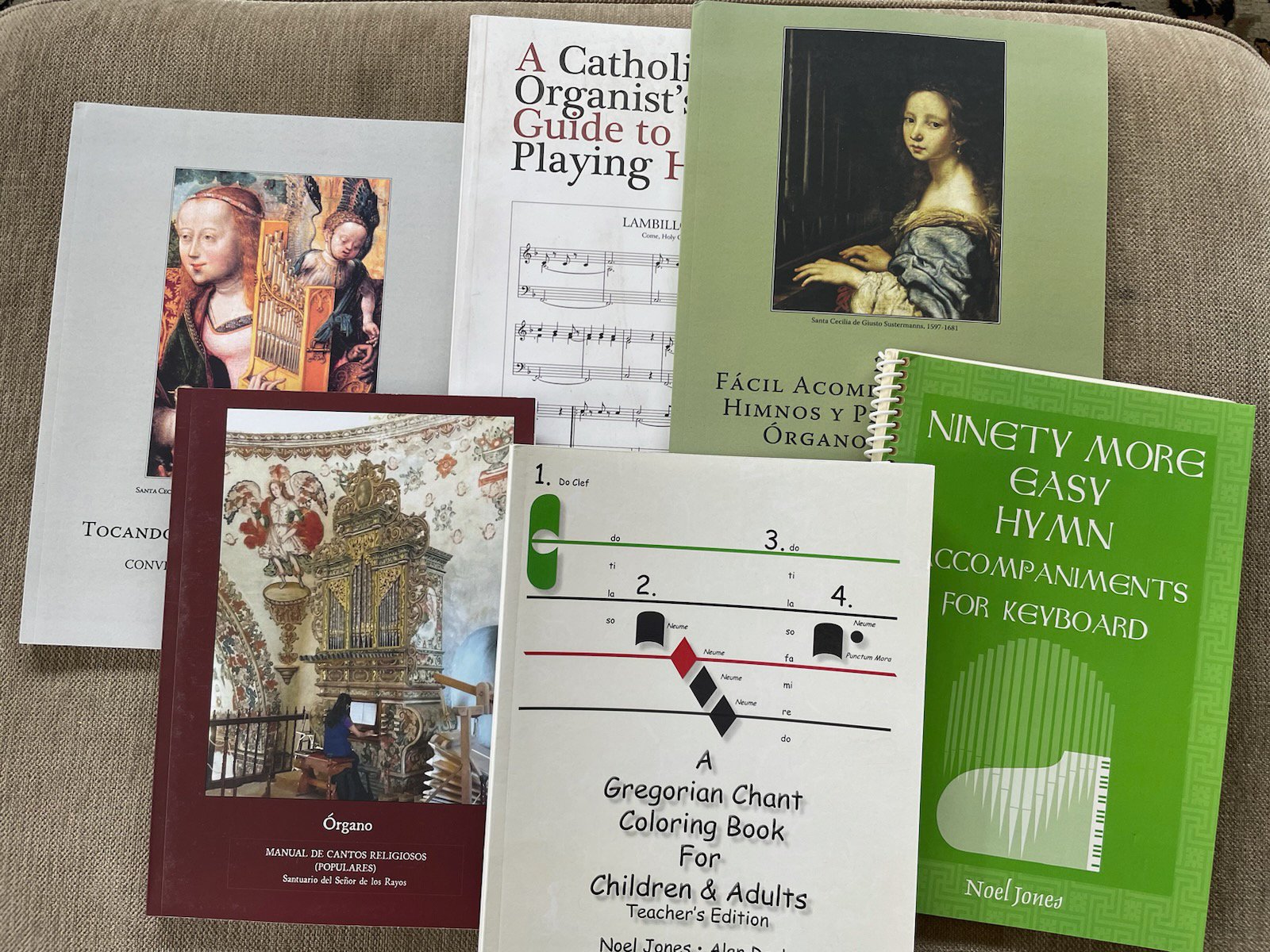
We have a Sponsor!! Thanks to https://sacredmusiclibrary.com/ , we have prizes: each student who finishes all 18 reading exercises in three weeks will get a free book (while supplies last, books are in Long Beach, CA) . See on the picture on the left which book is your first choice!
Week 4 Exercises (7/17 – 7/24):
The Parish Book of Chant :
Dialogues and Ordinary: Practicing solfege with the Parish Book of Chant (dialogues and ordinary)
Hymns: Practicing solfege with the Parish Book of Chant (Latin chant hymns)
Wednesday 7/26 – 7:00-7:30PM:
GOOGLE MEET – The circle of fifths, using the Movable Do with modern notation
Week 5 Exercises (7/24 – 7/31):
5-line staff
the Roman Missal: Practicing Solfege with the 2011 Roman Missal (ICEL)
Hymns: Practicing solfege with a Catholic Book of Hymns
Wednesday 8/2 – 7:00-7:30PM:
GOOGLE MEET – topics TBD
Week 6 Exercises (7/31 – 8/7):
Level 2 of each (6): 1-DO on 4th line – Intervals: seconds – low , 2-DO on 4th line – Intervals: seconds – high , 9-DO on 3rd line – Intervals: seconds – low , 10-DO on 3rd Line – Intervals: seconds – high , 17-FA on 3rd line – Intervals: seconds – low , 18-FA on 3rd line – Intervals: seconds – high
Wednesday 8/9 – 7:00-7:30PM:
GOOGLE MEET – Topics TBD
Week 7 Exercises (8/7 – 8/14):
Level 2 of each (6): 3-DO on 4th line – Intervals: thirds – low , 4-DO on 4th line – Intervals: thirds – high , 11-DO on 3rd line – Intervals: thirds – low , 12-DO on 3rd line – Intervals: thirds – high , 19-FA on 3rd line – Intervals: thirds – low , 20-FA on 3rd line – Intervals: thirds – high
Wednesday 8/16 – 7:00-7:30PM:
GOOGLE MEET – Topics TBD
Week 8 Exercises (8/14 – 8/21):
Level 2 of each (6): 5-DO on 4th line – Intervals: fourths – low, 7-DO on 4th line – Intervals: fifths – low , 13-DO on 3rd line – Intervals: fourths – low , 15-DO on 3rd line – Intervals: fifths – low , 21-FA on 3rd line – Intervals: fourths – low , 23-FA on 3rd line – Intervals: fifths – low.
September schedule will be announced at the end of July…
Modality vs. Tonality, an introduction
Excerpts:
The entire raison d’être of modal music is to stretch the umbilical cord which connects it to its fundamental generating principle (the primal frequency) to the limit, only to be drawn inexorably back to the point of its beginning — and thus its ending. At this “point” when it once again becomes One with its creator, universal harmony is restored. In modal music intervals only have a function as they are related to their “creator”, not to each other. without their fundamental they cannot exist.(…)
It is literally pars pro toto.
Aurality (i.e. the ear) is the medium through which modality prospers, this and the body, which generates vibrations which the ear then follows. Modality can only be truly generated orally. If one aurally perceptible link is removed the circular or spiral chain is broken and the process of modal disintegration begins. (…)
The influence of tonality is insidious and deadly, that is if one has not learned to recognize its characteristics and to separate them from those of modality.
Read full article here:
Musical Obesity
CNP Articles – Musical Obesity
by Gary D. Penkala
Obesity is a very serious problem in the United States. Over 35% of adults are classified as obese [body mass index greater than 30]. The causes are over-eating, eating the wrong kinds of food, and lack of exercise. My assessment is that liturgical music programs in our parishes might just exceed this 35% rate; I would say well over half our parishes suffer from obese music programs.
Let me give some examples of musical obesity at Mass.
I. Over-Hymning
I’ve been to Masses where the congregation was asked to sing six hymns: Gathering, Preparation of the Gifts, three at Communion, and Sending Forth [and aren’t these titles telling]. Hymns are heavy material. They often have deep, poetic theology and multiple stanzas that tell a progressing story. They’re the Chateaubriand of congregational music. I can’t imagine singing six of these at one Mass, where the subliminal goal may be to keep Mass at 55 minutes or less anyway. The Church, in her wisdom, does not call for a single “hymn” during Mass, Yet for how many parishes is a standard diet of four at every Mass the norm?
Healthy adjustment
Just like dieters learn to replace Whoppers/Fries with Salads, and Lasagna with Pasta Primavera, and Pound Cake with Angel Food Cake, so too should the health-conscious music director begin replacing hymns. Not all at once, but gradually. There are easy ways to start.
Replace the Communion Hymn with a Communion Psalm, where the congregation needs to sing only a refrain. This could be any of the hundreds of Responsorial Psalms available in your worship book. You could make up your own refrains, using a section of a familiar hymn (e.g. the first part of “At the Lamb’s High Feast We Sing”). The cantor or choir could chant psalm verses to a Gregorian or Meinrad tone.
The Offertory Hymn is the one most often replaced already, usually by a choral motet. At non-choir Masses this could certainly be an organ piece. Or you might introduce the congregation to a Proper they’ve never heard, since these antiphons were not translated into English in the Roman Missal. They’re available at Offertory Antiphons, and you could sing them to a familiar tone.
The Introit has the potential for making perhaps the most impact, and may be the hardest to “pastorally” implement. There are numerous sources for this Proper — just visit any CNP Liturgical Planning Page. However, the absolute easiest, no-excuses method for singing the Introit Proper is found in our recently-completed Mass Propers for the Liturgical Year. These are simple, straightforward ways to begin singing the Propers instantly!
It’s also possible to drop the Closing Hymn, replacing it with an organ recessional. There’s nothing called for here in the rubrics anyway — and the people might just enjoy being able to leave when the deacon really says, “Go!” A less drastic path might be to sing a consistent, brief antiphon prior to the organ music. The seasonal Marian antiphons [Alma redmeptoris Mater, Ave Regina cælorum, Regina cæli, Salve Regina] are great for this. An argument can also be made that, since the rubrics say nothing about what kind of music should happen at the end of Mass, this is a convenient place for a congregational hymn, since no Propers are being omitted.
II. Surfeit of Music
It’s laudable to use the Rite of Sprinkling during the Easter Season, in fact, the Roman Missal recommends it. This is normally accompanied by singing. But just what does this do to the”heaviness” of the Introductory Rites during Eastertide? Imagine: singing a multi-verse Opening Song, then another hymn during the Sprinkling, immediately followed by a through-composed Gloria. It’s like Country Paté, then Caesar Salad, plus Creamy Clam Chowder; and we’re not even at the entrée yet! Can you feel the bloat?
Healthy adjustment
Streamline. Combine some of the disparate music. Sing verses of the same hymn for Entrance and Sprinkling. Or have the choir sing Vidi aquam during the Sprinkling — yes, it’s legit! Be careful what kind of Gloria is sung.
III. Gloria
Speaking of the Gloria — this is likely the biggest block of music that will be sung at Mass (unless you sing the Credo). It’s rich, dense, heady text. There are several ways composer approach this hymn (one of the few precribed in the liturgy):
Through-composed — the congregation sings everything
Through-composed, but with a choral middle section
Alternatim — the cantor or choir alternates phrases with the congregation
Responsorial — a congregational refrain is sung between choral verses… Please don’t use this one, except as a temporary measure to familiarize the congregation with the entire Gloria!
Healthy adjustment
Format 1 is the heaviest, since the congregation sings the whole thing with no break. Think of this as a thick slab of Prime Rib. Format 2 is less heavy, since the people get a break in the middle, but it requires a choral group and won’t work at the other Sunday Masses. This is perhaps a moderate Ribeye Steak. Format 3 is the best option for the Roman Rite; it’s used almost exclusively at the Vatican, and has centuries of precedence. It makes for a comfortable interplay between cantor (or choir) and congregation. It’s a Beef Kebob, with healthy vegetables between the chunks of meat. Format 4 is an aberration, a quirk, an anomaly, which destroys the structure of the Gloria as found in the Roman Missal. It’s no more correct than singing, “Lamb, Lamb, Lamb of God, you take, take take away…” Don’t even consider using this … ground meat by-product!
IV. Communion Concentrate
Some Music Directors take the Church’s rubric about congregational singing at Communion time to a ridiculous extreme, programming one hymn after another, just to keep the crowd singing. That’s exhausting!
Healthy adjustment
Participation (a laudable goal) is not tethered to our vocal cords. The congregation can listen to organ music, choral music, or instrumental music during part of Communion time. Using some of these would alleviate the “revival-tent-hymn-sing” atmosphere from singing many hymns in a row.
V. Over Amplification
A strong cantor singing into a microphone can carry a hymn alone. Why does the congregation need to sing at all? The hymn “happens” whether they sing or not. And this amplificatis is an epidemic that has infected almost every Catholic church in the country. It’s amazing what ensues when the congregation is needed for music to happen — they’re not just an addendum to a miked soloist. Congregational singing in churches flourished before the advent of Shure and Dolby. It can still happen — heavens! what would we do in a power outage?
Healthy adjustment
Move the cantor back a few steps for hymns; or don’t use the microphone at all.
Try a verse without any accompaniment; let the people hear themselves!
Try a whole hymn without accompaniment. Come on, you’re doing it already during the Triduum… or you should be. It can happen more often — Advent? Lent?
In general, we can avoid the problem of musical obesity in our churches if we consider balance. Too much of anything upsets the equilibrium inherent in the noble Roman Rite. Gonna have meatloaf and mashed potatoes for dinner — think about some fruit for lunch. Chicken Pot Pie coming this weekend — work in a Stir Fry the day before. And more importantly, when you plan Sunday’s liturgy, don’t swing out the plastic music template with four hymn-holes in it. Be fresh, be creative, be healthy. Chuck some of those carnivorous hymns for a Proper or two. We’re all aware of the deadly health outcome of four Big Macs a day; four hymns are similarly lethal to liturgy.
Article written 29 August 2015
Demystifying pitch-matching
This is a very important topic for new singers. Listen to the short segment 3:30-8:00 if you have no time for the whole thing.

