Many musical styles, only one “source and summit”.
In our previous recent posts, we emphasized the importance of the official liturgical books like the Graduale Romanum. Yet, at mass in 2022 in North America, we hear many musical styles. Hymns are especially common. Archbishop Sample, in his 2019 pastoral letter, explains:
Hymns are a musical form pertaining more properly to the Liturgy of the Hours, rather than the Mass. Hymn-singing at Mass originated in the custom of the people singing vernacular devotional hymns at Low Mass during the celebrant’s silent recitation of the Latin prayers. […]
Singing hymns in place of the Proper chants is permissible for pastoral reasons. The liturgical norms put the highest priority on singing the rite itself. We may never substitute other texts for the Ordinary parts of the Mass as described above. However, if it is not possible or practical to sing the Proper parts, we are referred to a secondary option*: substituting music from a source other than the Missal, such as hymns from a hymnal.
“Sing to the LORD a New Song” Pastoral Letter of the Archbishop of Portland, OR, the Most Rev. Alexander K. Sample. (* this secondary option is not available for a sung mass following the 1962 missal, called “Traditional Latin Mass”. A hymn may only be sung after the proper has been sung).
Archbishop Sample thus sums up: “Our celebrations should faithfully carry out the Church’s plan as far as we are able, according to the resources and talents of the community, formed by knowledge of the norms and Catholic worship tradition.”.
So let us distinguish two situations when we may not be singing the Mass from the Graduale Romanum:
- a community with resources and talents who can not only sing from the Graduale Romanum, but improve on it. An obvious example are the solemn masses at St Peter in Rome where the expert choir often sings elaborate polyphony building on the texts and melodies of the “Catholic worship tradition”.
- a community not yet able to sing from the Graduale Romanum. For those, the mission statement from the publisher “Source and Summit” , summed up below, offers a useful guideline.
To begin, we see the image of a mountain. The liturgy is celebrated at the summit, at the mountain peak. Here we climb, week after week and day after day, with Moses and Elijah, and with Peter, James, and John, to seek the face of God. (…)
We also see that the liturgy, situated at the mountain summit, is also a font. The waters from this font flow out of the right side of the temple that is set upon the mountain peak, and pour constantly down the mountainside. These waters are you and me — those who participate in the liturgy, who are made into the image of Christ, and are poured forth on mission to proclaim the gospel to the world. (…)
The journey from source to summit passes through four general realms of the Church’s life. These realms can be seen as a series of four concentric circles:

1- The largest circle is the realm of culture at large. Catholic musicians in this realm need not hide from the world, but engage with it, cultivate their craft as excellently as they can, and work to take center stage in the world, forming the culture with the beauty that comes from God.
2- Within this we find the realm of evangelization. Music that is aimed toward the purpose of evangelization, as a result, tends both to be based in the music of the culture in some way, and also seeks somehow to present a powerful encounter with Christ and the gospel through it.
3- And then the realm of discipleship and devotion. Music has been an effective tool for formation and instruction since the early centuries of the Church. St. Ambrose wrote hymns in the fourth century specifically to help impart sound doctrine to Christians, and catechetical hymns and songs like this have been sung in every age to hand on the faith and to present it beautifully and attractively to the next generation.
4- And finally, at the very center, we find liturgy and worship. The music of the liturgy is set apart from the music used in the other realms of the Catholic journey because it sets the words of the liturgy itself to music.
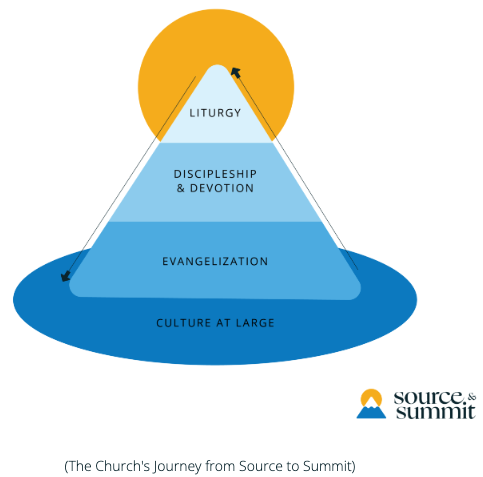
I hope this clarifies why we hear so many musical styles in worship. When properly ordered, every style of music can accompany a specific part of the journey, from font to the culture at large, back to the summit.
To be informed about future posts, consider subscribing:
What is the Graduale Romanum ?
The Graduale Romanum, or Roman Gradual, comes… from Rome! It contains the chants for the Mass in the Roman Rite of the Catholic Church.
The early church in Rome worshipped by singing the psalms :
In the early church the psalms are prayed and sung as hymns to Christ. Christ himself thus becomes the choir director who teaches us the new song and gives the Church the tone and the way in which she can praise God appropriately and blend into the heavenly liturgy.
Ratzinger, New Song, 96–97 quoted by Mark Daniel Kirby – Sacred Music 2009
The Church holds her ear to the psalter to learn from the psalms not only her own song, but the song of Christ as well. In the antiphons and psalmody of the Graduale Romanum, the Graduale Simplex, the antiphonal of the hours, and other liturgical books, Christ is present as the one addressing the Father, as the one addressing the church, or as the one to whom the church addresses her supplications and her praise.
Mark Daniel Kirby – Sacred Music 2009
This “song of Christ” was not written down as music on paper for centuries, but lived as an oral tradition in the liturgy of the early Church. The oldest records of the music of the mass notated are from the 9th and 10th century, and they look like this:
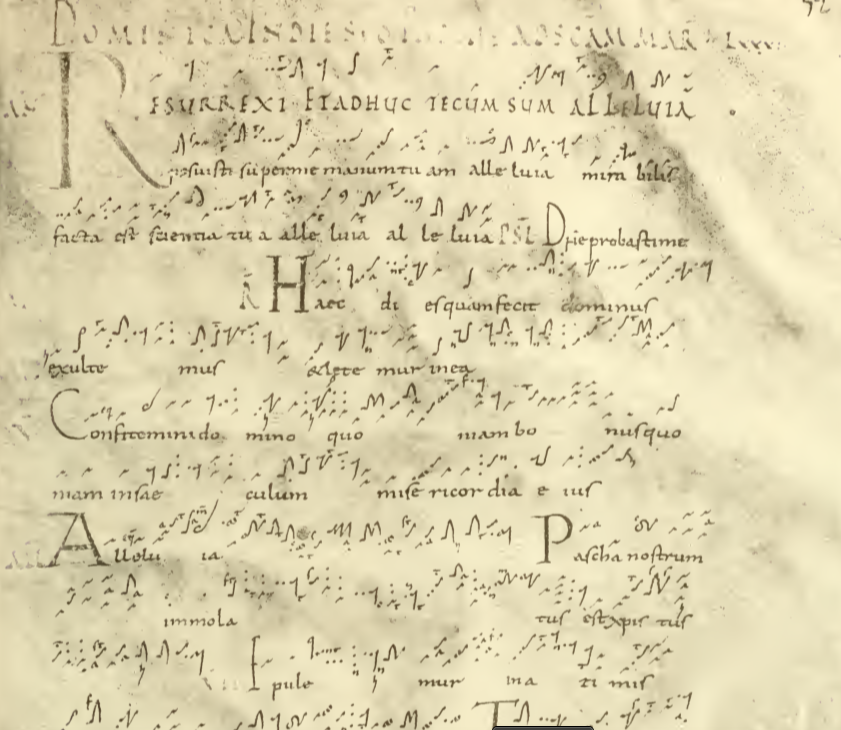
The musical writing above the text is just mnemonic: a shorthand for the singer to help remember the melody. But the writing cannot yet replace oral transmission. Only in the 11th century were lines added, and in the 14th century the shorthand became “square notes”, so that the singer could better see if the note was on the line, or in the space between the line. Below is the current “square notes” setting of “Gustate et Videte”, a communion antiphon, along with the writing that accompanied that text in the liturgy songbooks from the 9th century (in Red, from a Swiss monastery) and 10th century (in black, from a French monastery):
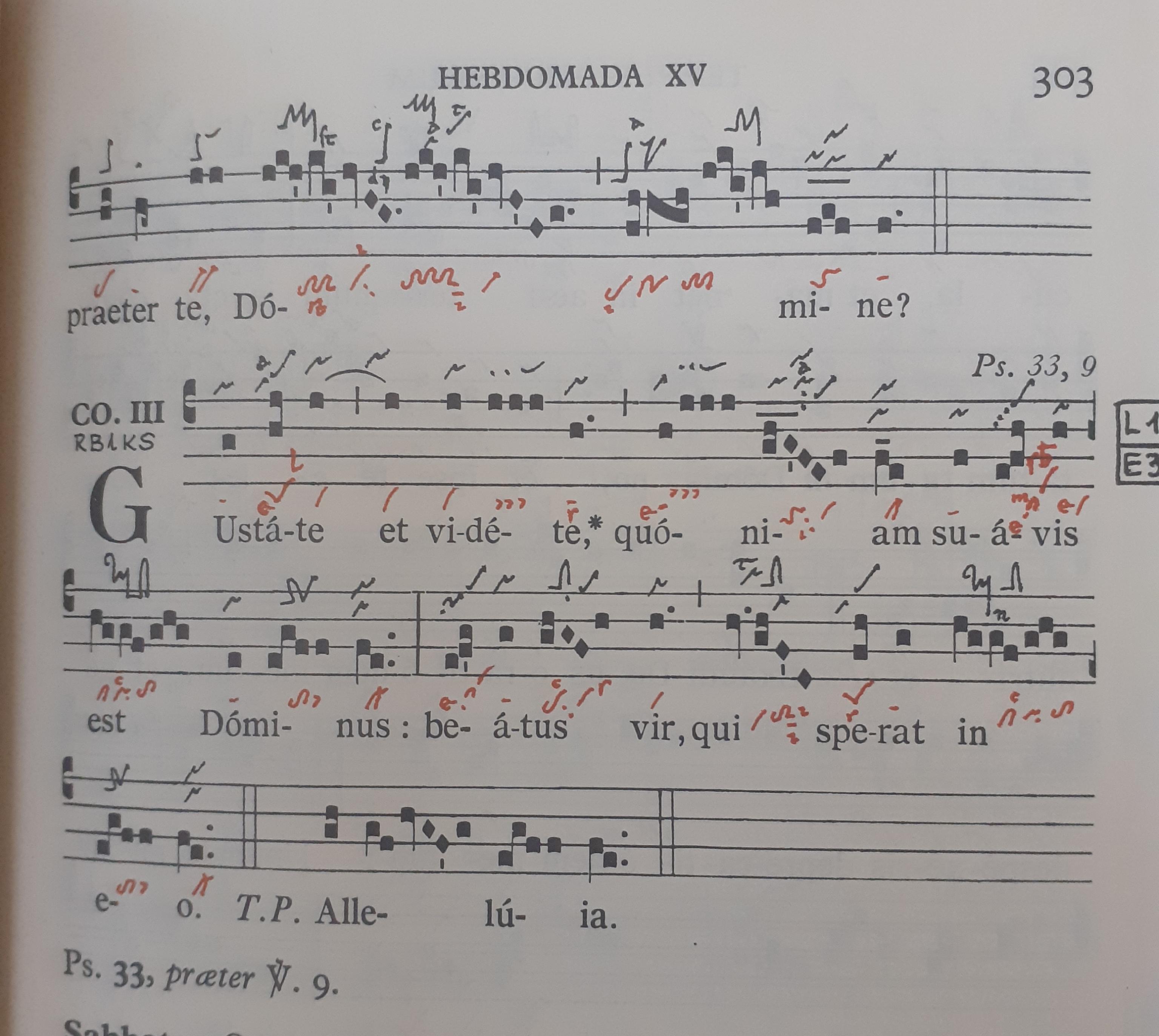
Hopefully, this example shows how the “song of Christ” in the Graduale Romanum has been transmitted so we can sing the Mass today in communion with all the saints who sang the same melodies throughout the centuries. “Gustate et Videte” will be sung this coming Sunday in the Traditional Latin Mass.
To be informed of future posts, consider subscribing:
How do we choose the music for mass?
The mass is part of the liturgy of the Church. The liturgy starts with the Trinity, not with us humans. So how does the schola director plan the music for mass?
It is important to keep in mind that we do not plan Holy Mass; the Church has already provided us with a plan. We prepare to celebrate the Mass. This is a subtle yet important distinction. The plan is found in the liturgical calendar and the official liturgical books: the Ordo, the Missal, the Lectionary and the Graduale. Our celebrations should faithfully carry out the Church’s plan as far as we are able, according to the resources and talents of the community, formed by knowledge of the norms and Catholic worship tradition.
Sing to the Lord a new song, pastoral letter from Archbishop Sample (2019)
So the music director starts with the Graduale Romanum (Roman Gradual, see Books, Books, Books to download a copy). In the Graduale, the text of the mass for each Sunday is set to music, and divided in three categories :
- the dialogues
- the ordinary (ex: Kyrie, Gloria, Credo, Sanctus, Agnus Dei)
- the proper (ex: Introit, Gradual, Alleluia, Offertory, Communion)
SS Pope Pius X, in his Motu Proprio “Tra Le Sollicitudine” in 1903, reminded the Church how Gregorian Chant fosters active participation. This resulted in the current form of the Graduale Romanum.
Special efforts are to be made to restore the use of the Gregorian Chant by the people, so that the
Tra Le Sollicitudine , SS Pope Pius X 1903
faithful may again take a more active part in the ecclesiastical offices, as was the case in ancient times.
The three sections of the Gradual Romanum correspond to “degrees of participation” of the faithful at Mass:
Dialogues: simplest chant, repeating every Sunday, so that all the faithful must participate in the response (1st degree)
Ordinary: syllabic chant (one note per syllable), easy to learn with a small effort, the texts never change, so that most of the faithful can participate in singing (2nd degree). For more on the Ordinary, see the short video below.
Proper: often melismatic chant (several notes per syllable) requiring more vocal training (ex: breath support) as well as some reading of music notation, as the texts change with every mass. This is the part of the mass sung by the schola (3rd degree).
So for the schola director, choosing the music for mass consists in 1- preparing “the resources and talents of the community” to sing as much as possible from the Graduale Romanum. 2- Choosing complementary music (= not from the Graduale Romanum) that will help both the schola and the congregation prepare to sing from the Graduale Romanum in the future.
As Archbishop Sample wrote, “the Church already provided us with a plan”… In our next post, we will see where the “plan” (the Graduale Romanum) comes from…. To be informed of future posts, consider subscribing:
 Long Beach Chant