Singing as sacrifice
We can also draw some conclusions about musical practice in the Church, especially this time of year, right around the Feast of St. Cecilia, early Christian martyr, and patron saint of music. Our worship should be as musical as Israel’s worship was sacrificial. That is to say, it should be thoroughly and completely musical, as musical as we can make it. As James B. Jordan likes to say, If you can sing it, why say it? Israelites had to offer physically perfect animals “without blemish.” Our musical worship should aspire to exhibit the same quality. Are our musical offerings the best we can offer? Are they true? Are they lovely? Is this hymn, Psalm, canticle suitable to ascend to the presence of God? Will it be sweet-sounding in his ear?
Finally, we do not have the luxury of delegating this responsibility to “professionals.” Each member of the Church has unique gifts to serve the body. Some lead and exercise authority; some teach; some are shepherds. Choirs have their place. Accompanists are essential, and instrumental ensembles are good. But every baptized Christian is a priest, and all offer the sacrifice of praise together. If you sing badly, sing badly to the Lord, or learn to sing better. You do not have the option of being silent. If you are baptized, you are a priest. It is your job to offer a sacrifice of praise. Singing is one of your main jobs. So sing.
https://churchlifejournal.nd.edu/articles/the-sacrifice-of-praise-and-animal-sacrifice/

Square Notes Podcast Episode 1
This podcast has now been going on and providing valuable information to Church musicians for a few years. This first episode with Archbishop Sample is definitely worth a listen.
Archbishop Sample’s pastoral letter which is discussed in the podcast can be downloaded here:
Chant and “Nowhere else to be”
This video is gold. In just 4 minutes, from 7:57 to 11:45, Brother John explains what i always wanted to express to other musicians… but never knew how. He does it by a wonderful description of modality, its similarity to jazz, opposing the “resolution” concept in the major and minor keys of modern music to the “hic et nunc” (here and now) of chant. Chant is the most appropriate music in the liturgy because it expresses that we have “nowhere else to be”. Chant actualizes timelessness. This video is a must-watch!!!
You may have noticed that the above video was the second of a 2-part series. The most interesting part, in my opinion. But if you are not as excited as I am, you may find it helpful to watch the first part, below.
The Elements of the Catholic Mass (13)
To be informed of our future posts, please consider subscribing:
The Elements of the Catholic Mass (12)
To be informed of our future posts, please consider subscribing:
Active Participation, a-cappella, and in Latin. An example.
Not all went well at last Sunday’s mass at this link but it is nonetheless an illustration that following the Liturgy books and Church documents on music strictly can result in active participation. Most singing is from the Roman Gradual, the official songbook of the Church, the congregation was trained to follow the degrees of participation defined in Musicam Sacram, the 1967 document on liturgy: dialogues are the most important, then the Kyriale and the Credo. The schola sings the proper. This active participation can even (or especially?) happen in a congregation that is singing… A-CAPPELLA (without instrumental accompaniment).
Pope Francis is correct in calling for a better implementation of the Liturgy Books… these books « work »…
https://www.facebook.com/frhenry.white.5/videos/425282629648668/
To make it easier to watch the video at the link above, below are the time markers:
0:00 Rosary ;
8:48 English Hymn (Congregation) ;
11:53 Asperges (Schola) ;
15:40 Simple Introit in English (schola) ;
16:53 Introit in Latin (Cantor/schola) ;
20:00 Kyrie VIII (Cantor/Congregation) ;
22:15 Gloria VIII (Priest/Cantor/Congregation) ; 24:41 Collect (Priest/Congregation) ;
25:35 Epistle (Priest+answer from Cong.) ;
27:05 Gradual & Alleluia (Cantor / Schola);
28:30 Gospel (Priest/congreg) ;
32:30 readings in English + Homely (only spoken parts of the Missa Cantata) ;
42:00 Credo (Priest/cantor/congregation) ; 46:20 Offertory + verse (Cantor/schola) ;
48:35-50:35 Hymn Adoro te Devote 2-voice harmony (schola) ;
52:10 Preface Dialogues (Priest/congregation) ; 54:50 Sanctus VIII (congregation) ;
56:30 Secret (silent) ;
1:03:25 Agnus Dei VIII (congregation) ;
1:05:25 Confiteor (congregation, spoken) ; 1:10:00 Communion antiphon + verses (cantor/schola) :
1:15:35 Ave Verum hymn (schola) ;
1:17:40-1:19:30 Panis Angelicus hymn (2-voice , schola) ;
1:24:00 Ite Missa Est VIII (priest/congregation) ; 1:24:40 Salve Regina (congregation). Please note that all the singing participation is A-CAPPELLA.
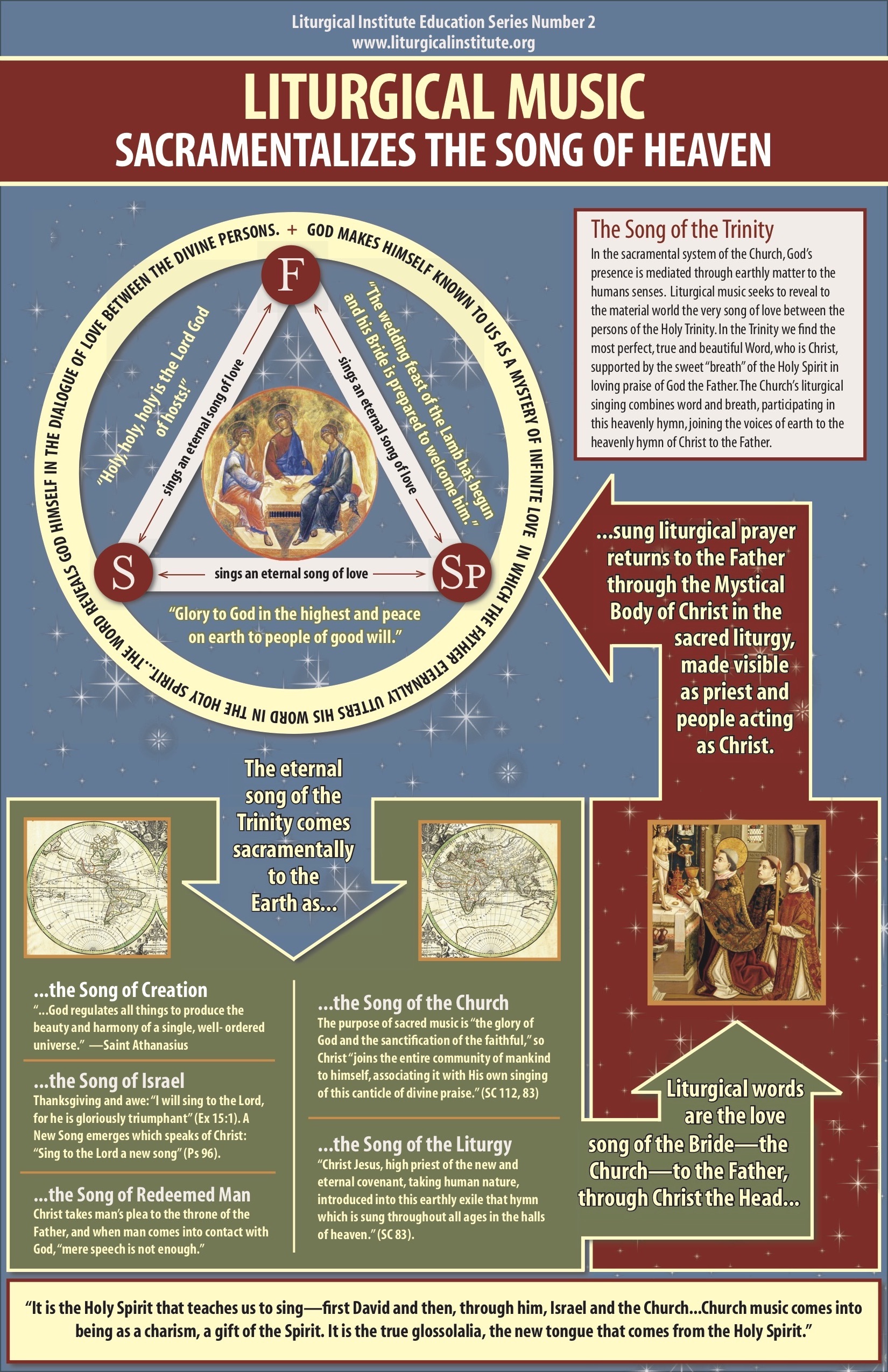
Liturgical Chant and the Trinity
The first five minutes of this 5-hour class from Liturgical Institute on the theology of liturgical music gives a good start into understanding how Liturgical Chant sacramentalizes the Trinity.
To learn more, visit the Liturgical Institute online classes, and/or download the sum-up below:
To be informed of our future posts, consider subscribing:
 Long Beach Chant