Does it matter what music we use at mass?
Being attentive to how we celebrate the liturgy can have a profound impact on how we live our Catholic faith more broadly, Higgins told The Pillar.
The phrase “source and summit” is often used in many Catholic circles to refer to the Eucharist alone, he noted. “But when you read the texts of the Sacrosanctum concilium (the constitution on the liturgy from the Second Vatican Council), [the phrase] actually refers to the liturgy as the source and summit of our faith, with the celebration of the Eucharist being the pinnacle of that.”

This means that when the liturgy is celebrated well, and in its proper context as the summit of the faith, the rest of the Catholic life and mission — from evangelization and catechesis to the devotional life — can “flow from that,” Higgins said.
“When we do liturgy correctly — as joining Christ in his prayer to the Father rather than something that we bring from our own perspective, then conform ourselves to Christ…we join him and become like him and we go out into the world from that experience, and it improves everything about our mission.”
READ FULL ARTICLE BY CLICKING BELOW:
Traditional Latin Mass: finding the Proper antiphons of the Mass
One difficulty for newcomers to the Traditional Latin Mass is to identify the “proper of the mass”. For aspiring choir members especially, these proper will explain why we sing what we sing. We sing the mass, we just do not sing at mass.
The first step is to locate the date of the calendar we know (ex: Sunday October 31st, 2021) into a date of the Liturgical Calendar.
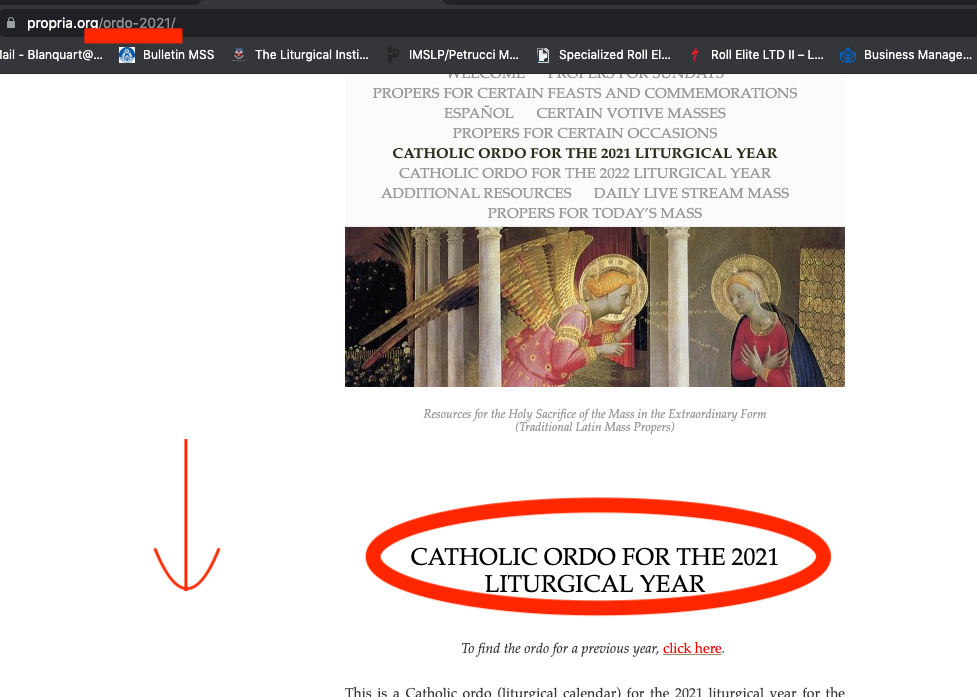
For this, we recommend to use the http://www.propria.org website. There are others, but this is a good one. You will then see “CATHOLIC ORDO FOR THE 2021 LITURGICAL YEAR”

CLICK on the link to go to the “Ordo 2021” page. Then scroll down until you find the date you are looking for….
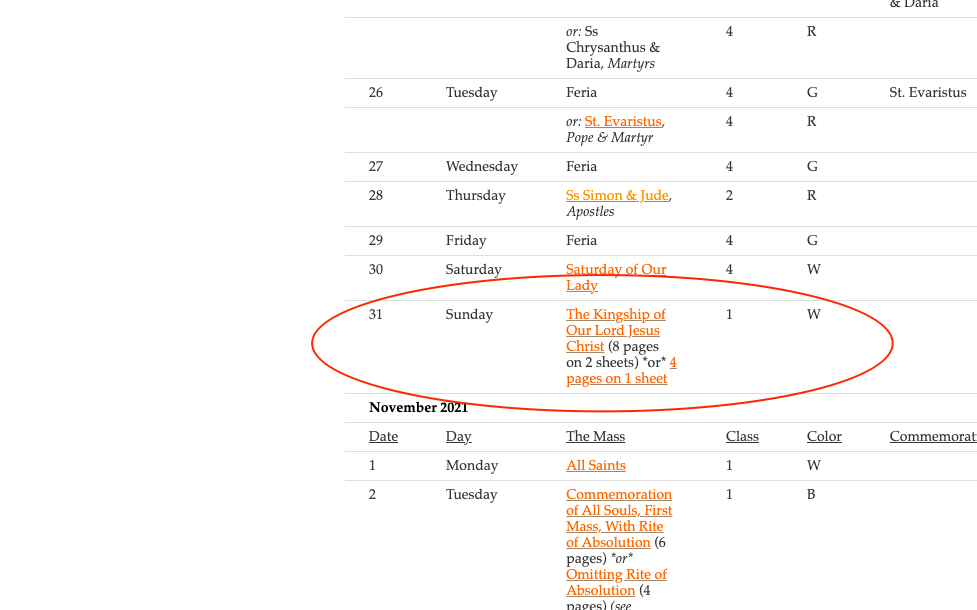
… When you see “SUNDAY OCTOBER 31th”, stop. Read across: On that specific Sunday “the Kingship of our Lord Jesus Christ” is celebrated. CLICK on that link…
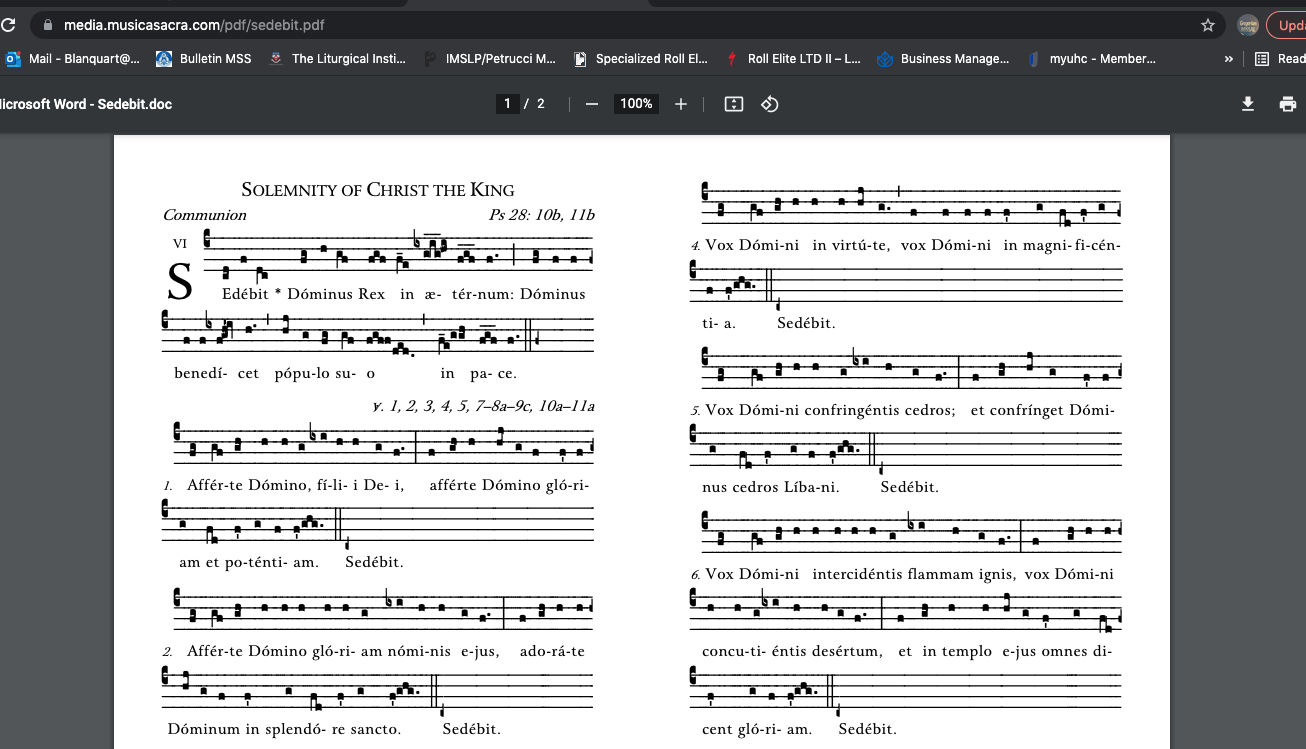
… and you will see the proper for the Sunday you were looking for… This is only text. If you want the sheet music for the SUNG PROPER, you can consult the LIBER USUALIS (see Books, books, books,… ) or many other internet resources. In the below example, we will assume you are a beginner with singing the Traditional Latin Mass. The simplest antiphon is generally the Communion, and even simpler are the psalm verses, usually sung on a Psalm Tone (see Psalm tones )…. Let us find the sheet music for this Communion Antiphon : “Sedebit Dominus”…

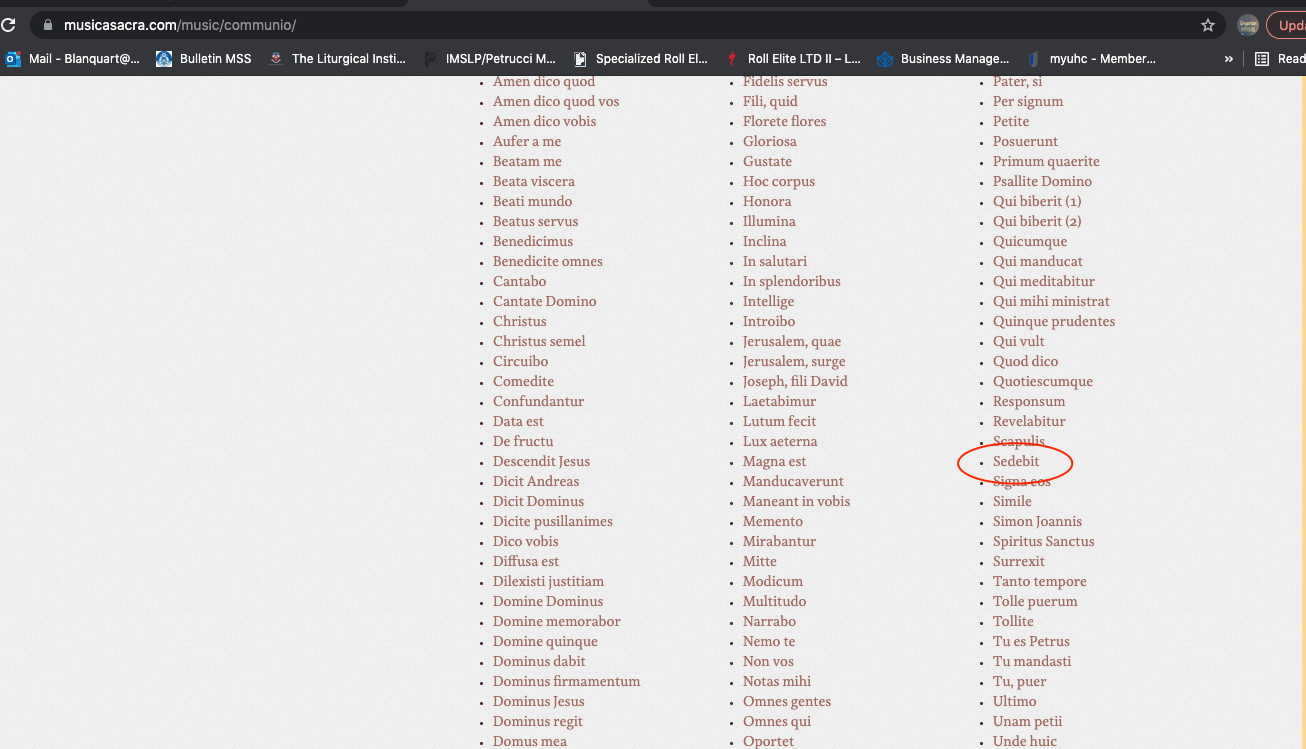
The website http://www.musicasacra.com includes many, many resources, like a wonderful book called COMMUNIO, free of charge. Go to the COMMUNIO page of http://www.musicasacra.com (see below)… Scroll down…

… until you find the “Sedebit” antiphon you identified earlier (antiphons are usually identified by their first word(s) ). CLICK…
… ET VOILÀ. Now you have the sheet music to join the schola in singing the Communion antiphon and verses.
A Catholic Book of Hymns
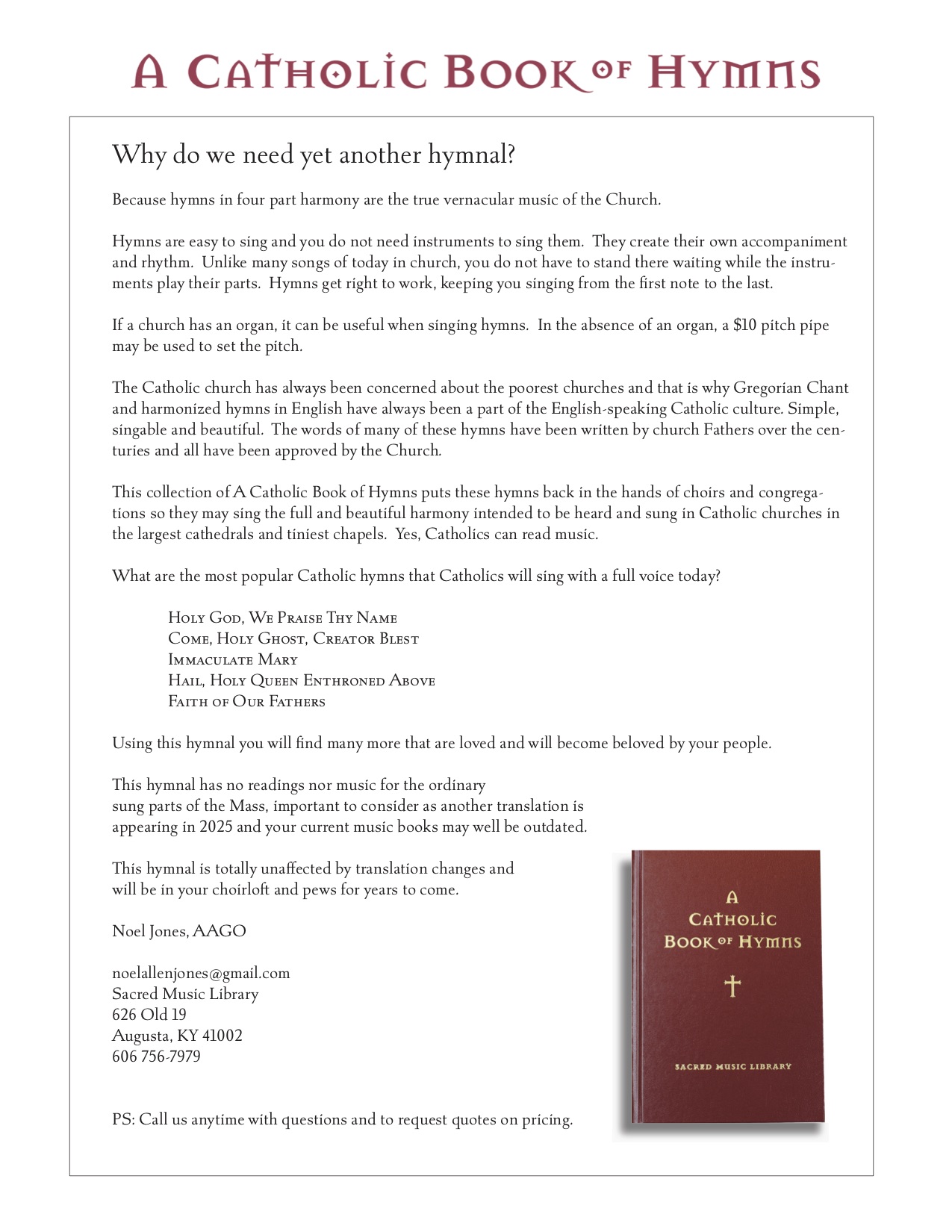
DOWNLOAD A 40-PAGE SAMPLE OF THE HYMNAL BY CLICKING HERE


Tuning our mind to our voice…
In 1963, as a result of the Ecumenical Council Vatican II, Pope Paul VI promulgated the ” Constitution
on the sacred liturgy”. One of the early paragraphs links “proper disposition” to “minds…attuned to.. voices”.
11. But in order that the liturgy may be able to produce its full effects, it is necessary that the faithful come to it with proper dispositions, that their minds should be attuned to their voices, and that they should cooperate with divine grace lest they receive it in vain. Pastors of souls must therefore realize that, when the liturgy is celebrated, something more is required than the mere observation of the laws governing valid and licit celebration; it is their duty also to ensure that the faithful take part fully aware of what they are doing, actively engaged in the rite, and enriched by its effects.
Constitutution on the sacred liturgy (1963)
What does that mean? Should we not think before we speak? Should we not tune our voice to our minds, not the reverse? There is an exception: when our voice carries the Word, the Logos. To understand, it is helpful to read what St Benedict’s rule 19 for singing the Psalms has been:
CHAPTER 19. THE DISCIPLINE OF PSALMODY We believe that the divine presence is everywhere and
The Rule of St Benedict (written in 516AD)
that in every place the eyes of the Lord are watching the good and the wicked (Prov 15:3). But beyond the least
doubt we should believe this to be especially true when we celebrate the divine office. We must always
remember, therefore, what the Prophet says: Serve the Lord with fear (Ps 2:11),and again, Sing praise wisely
(Ps 46[47]:8); and, In the presence of the angels I will sing to you (Ps 137[138]:1). Let us consider, then, how
we ought to behave in the presence of God and his angels, and let us stand to sing the psalms in such a way that our minds are in harmony with our voices.
Singing the Mass is like singing the Word, or singing the Logos. When we sing the Mass, our minds should be in harmony with our voices. This other excerpt of Vatican II’s Constitution on the sacred liturgy then takes its full meaning:
116. The Church acknowledges Gregorian chant as specially suited to the Roman liturgy
Source and Summit (3)
The National Association of Pastoral Musicians (NPM) invited Adam Bartlett to present the Source & Summit revolutionary missal and digital platform. NPM is dedicated to the protecting the income of pastoral musicians, and they know that the “big box missals”, down 60% in sales, are on their way out…. Source & Summit is showing the future of liturgical music publication.
 Long Beach Chant